 Tea Mystery
Back to the journal
Tea Mystery
Back to the journal
The journal · Essay
Seven Bowls, One Conscience
A Tang poet drinks from thirst to transcendence, then asks who paid for the tea. Read whole, Lu Tong's Seven Bowls is not a quaint tasting note or a seven-cup prescription. It is a journey through body, mind, spirit, and moral responsibility.
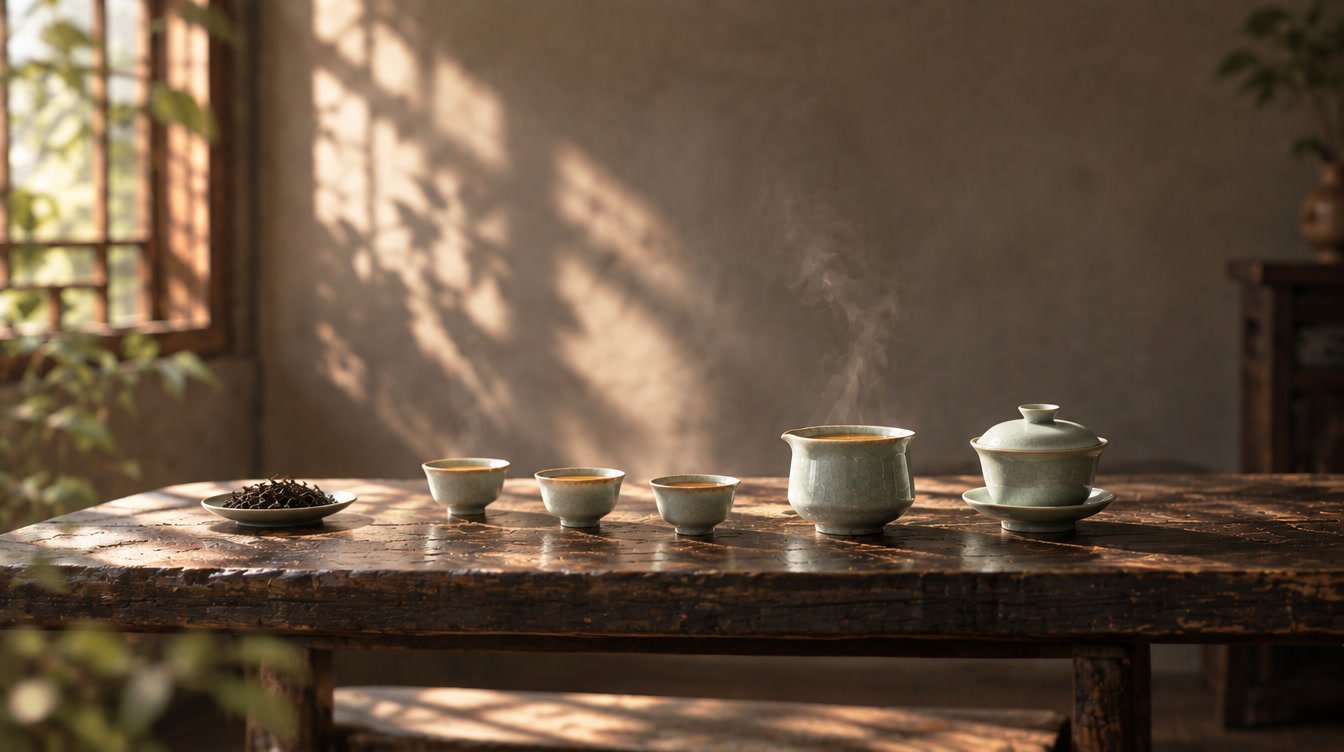
The tea arrives like a summons.
Lu Tong is asleep late in the morning when a military messenger hammers at his gate. The parcel is wrapped in white silk and closed with three seals. Inside are three hundred round cakes of precious spring tea from Yangxian, an imperial tribute region in what is now the Yixing area of Jiangsu.[1][8] Lu Tong can scarcely believe that tea fit first for the emperor and then for princes has reached the hut of a recluse.
He shuts his brushwood gate, keeps ordinary callers out, puts on his gauze cap, and prepares the tea alone. Green clouds of infusion move in the vessel; white froth shines on the surface. Then come the lines that have travelled through a thousand years of tea culture:
一碗喉吻潤,兩碗破孤悶。
三碗搜枯腸,唯有文字五千卷。
四碗發輕汗,平生不平事,盡向毛孔散。
五碗肌骨清,六碗通仙靈。
七碗吃不得也,唯覺兩腋習習清風生。
One bowl moistens lips and throat.
Two bowls break lonely gloom.
Three bowls search my withered gut,
and find only five thousand scrolls of words.
Four bowls raise a light sweat;
the injustices of a lifetime stream out through every pore.
Five bowls make flesh and bone clear.
Six bowls open communion with immortal spirits.
The seventh bowl I cannot drink:
I only feel a soft, clear wind rise beneath both arms.
Translation here and below is my own, based on the text in the Complete Tang Poems, juan 388.[1]
This passage is usually called the "Seven Bowls of Tea" or "Song of Seven Bowls." But it is only the most quoted movement of a longer poem, Zoubi xie Meng jianyi ji xincha (走筆謝孟諫議寄新茶), "Writing Rapidly in Thanks to Remonstrance Official Meng for Sending New Tea." Its full setting changes its meaning. The seven bowls do not end in private bliss. They lead to a public question.
First, what the seven bowls are not
They are not seven required steps in a historical ceremony. They are not a promise that a particular infusion will produce a particular sensation. And they are not evidence that ninth-century Tang drinkers practiced modern gongfu brewing.
They are a poetic crescendo.
Each bowl carries the speaker across a threshold: from dryness to comfort, from isolation to thought, from bodily release to purification, and from purification to imagined flight. The sequence matters more than any attempt to diagnose the chemistry of each serving. Lu Tong is describing what exceptional tea can mean when sensation, memory, learning, imagination, and conscience all become unusually vivid.
The choice of "bowl" also matters. The character wan (碗) means a bowl, larger than a cup; translating it as "cup" makes the scene feel more modern than it is.[2] The poem's vessel belongs to Tang material culture, not to a row of tiny contemporary gongfu cups.
One more useful distinction for newcomers: Lu Tong (盧仝), the poet, is not Lu Yu (陸羽), author of the eighth-century Classic of Tea. Their surnames look identical in Roman letters but are different Chinese characters. Lu Yu systematized tea knowledge; Lu Tong turned tea's effects into unforgettable verse.
Bowl by bowl: a map of transformation
The first bowlSensation before symbolism
"One bowl moistens lips and throat."
The poem starts with the least mystical fact possible: the tea relieves dryness. Before doctrine, connoisseurship, or transcendence, there is a mouth, a throat, and liquid. This is one reason the poem remains so convincing. Its ascent begins in direct sensory evidence.
For a gongfu drinker, the lesson is not to hunt immediately for a catalogue of orchid, stone fruit, incense, or "rock rhyme." First notice what the liquor actually does: temperature, texture, salivation, breath, aftertaste. Lu Tong gives the body first speaking rights.
The second bowlTea changes the emotional room
"Two bowls break lonely gloom."
The verb po (破) is forceful: to break, pierce, or shatter. Tea does not merely decorate Lu Tong's solitude; it alters it. He is still physically alone behind a closed gate, yet the gift reconnects him with its sender. The bowl contains a relationship.
This complicates the familiar picture of the solitary sage. Tea is both retreat and correspondence. Even alone, Lu Tong drinks within a social world: messenger, patron, emperor, producers, and eventually the common people all enter the poem.
The third bowlAn empty gut full of books
"Three bowls search my withered gut, and find only five thousand scrolls of words."
The comic exaggeration is pure Lu Tong. His insides are barren, but somehow packed with a library. Sou kuchang (搜枯腸), literally "search the withered intestines," later became an idiom for racking one's brains.[2] Here the image holds several possibilities at once: the poor scholar whose body contains books instead of food; the blocked writer suddenly searched awake by tea; the learned recluse discovering that language is his deepest substance.
It is tempting to flatten the line into "tea improves concentration." That is true as far as it goes, but the poem is stranger and richer. Tea does not simply sharpen Lu Tong's mind; it rummages through him and reveals that he has made a body out of literature.
The fourth bowlPrivate relief, political pressure
"Four bowls raise a light sweat; the injustices of a lifetime stream out through every pore."
Many English versions soften buping shi (不平事) into "cares," "troubles," or "the wrongs I have suffered." The phrase can include grievance and inner disquiet, but buping also carries the force of unfairness, things that are not level, not right. "Injustices" preserves the line's pressure and prepares us for the poem's ending.
At first the wrongs seem to leave the body as sweat. Yet Lu Tong has not forgotten them. The poem will soon return to hardship on a larger scale. The fourth bowl therefore marks a hinge: tea offers release, but release is not amnesia.
The fifth bowlClarity enters the frame
"Five bowls make flesh and bone clear."
The word qing (清) can suggest clarity, purity, cleanness, or lightness. Lu Tong's transformation has moved below mood and thought into the body's structure: flesh and bone become lucid. This is purification language, but it remains embodied. He is not escaping the body so much as experiencing it differently.
For experienced tea drinkers, this line may recall what is now often discussed as bodily response, the way heat, bitterness, fragrance, posture, expectation, and stimulant effect combine into a whole-body impression. The poem gives us permission to take such experience seriously without pretending that its metaphors are laboratory measurements.
The sixth bowlContact, not yet escape
"Six bowls open communion with immortal spirits."
The line is often rendered as enlightenment. That wording is attractive but too specific. Lu Tong writes tong xianling (通仙靈): to reach, communicate with, or pass into the numinous realm of immortals. The imagery is more directly at home in the language of Daoist transcendence than in a technical Buddhist account of awakening.
That does not exclude later Buddhist or Chan readings. In fact, the poem's reception across East Asia repeatedly adapted it to new religious and aesthetic settings. But historically responsible reading distinguishes the poem's wording from what later traditions made of it.[3]
The seventh bowlThe climax is a refusal
"The seventh bowl I cannot drink."
This is the line most often lost when "seven bowls" becomes a challenge or tasting format. Lu Tong does not triumphantly drain number seven. He reaches a limit. Before he can drink, or because six bowls have already carried him beyond ordinary capacity, he feels a gentle wind rising under his arms.
The image suggests the winged lightness of an immortal. He asks where Mount Penglai, the legendary abode of immortals, might be and imagines riding the clear wind "back" there under his literary name, Yuchuanzi, "Master of the Jade Stream."
The highest stage is not more consumption. It is the point at which another drink is unnecessary.
The ending that changes everything
If the poem stopped at the wind beneath Lu Tong's arms, it would be an exquisite fantasy of tea-induced transcendence. It does not stop.
Lu Tong imagines the immortals high on their mountain, overseeing the earth below from a position sheltered from wind and rain. Then the poem turns:
山上群仙司下土,地位清高隔風雨。
安得知百萬億蒼生命,墮在巔崖受辛苦。
便為諫議問蒼生,到頭還得蘇息否。
The host of immortals on the mountain governs the earth below,
their station pure and high, beyond wind and rain.
How could they know the lives of countless common people,
cast among peaks and cliffs to suffer hardship?
So, Remonstrance Official, ask on the people's behalf:
in the end, will they ever be allowed to rest?
The immortals suddenly resemble insulated officials. Their height is both spiritual elevation and political distance. The same mountain landscape that looked like an escape route now contains workers exposed to danger and hardship. The rare tea in Lu Tong's bowl has a labor history.
The addressee sharpens the point. Meng is addressed by a title associated with remonstrance, the duty of speaking critically to power. Lu Tong's thank-you poem becomes an act of admonition: you sent me this magnificent tea; now ask what its magnificence costs the people who make it.
Recent scholarship on the poem's East Asian reception argues that this political and Confucian concern was gradually pushed aside as later readers canonized the "seven bowls" and "wind beneath the arms" as signs of literati elegance, purity, inspiration, or tranquil tea practice.[3] Another study identifies the poem's tea ethos as a braid of Daoist aspiration, Confucian self-cultivation, and concern for suffering people.[4] Those categories can be debated, but they capture an essential fact: Lu Tong does not let spiritual refinement cancel ethical attention.
This is the poem's masterstroke. Tea first makes him weightless; then it makes him accountable.
What was actually in Lu Tong's bowl?
Not a modern loose-leaf oolong, and not tea brewed in a small Yixing pot.
The poem speaks of three hundred "moon rounds," compressed cakes. Its green-cloud and white-froth imagery belongs to a world in which prized tea could be processed into cakes, roasted before preparation, ground, sifted, and cooked in a cauldron. Lu Yu's Classic of Tea describes adding salt at the first boil, introducing the powdered tea during the next stage, and valuing the resulting foam.[5] Specific practice varied, but Lu Tong's scene is materially far closer to this Tang world than to later gongfu infusion.
Modern gongfu tea, with its high leaf-to-water ratios, small pots or gaiwans, small cups, and repeated short infusions, emerged many centuries later in the tea cultures of southeastern China. Its exact origin is debated, but historical evidence does not support a continuous gongfu ritual stretching unchanged back to the Tang. Ethnographic research describes gongfu in Chaoshan not only as refined "tea art" but as an everyday social practice that nourishes family, friendship, and local identity; it also warns against projecting that practice directly into Lu Yu's era.[6] The term gongfu cha itself appears in surviving sources much later; both 工夫茶 and 功夫茶 circulate, with 工夫茶 prominent in earlier usage.[7]
So why bring Lu Tong to a gongfu table at all?
Because influence and interpretation do not require identical equipment. The historical practices differ, but the poem offers a powerful vocabulary for the changes that repeated servings can disclose. Gongfu's successive infusions make time perceptible: aroma opens, structure shifts, bitterness resolves, sweetness returns, conversation deepens. Lu Tong's numbered bowls give that temporal experience a poetic form.
The honest relationship is analogy, not ancestry.
Seven questions for a modern gongfu session
There is no need to drink seven full bowls, force a bodily reaction, or treat the poem as a script. Instead, let its sequence sharpen observation. Across the first seven infusions of a normal session, ask:
- Body: What is the first clear physical sensation?
- Mood: Has the emotional atmosphere changed?
- Mind: What memory, idea, or association has surfaced?
- Tension: What has loosened, and what should not be forgotten?
- Clarity: How do posture, breath, and bodily attention feel now?
- Perspective: Has attention widened beyond flavor?
- Enough: Should I drink, pause, dilute, eat, or stop?
Then add the question supplied by the full poem rather than the famous excerpt:
Whose work is present in this cup?
That question can lead toward cultivar and place, but it should not end there. Who picked the leaf? Who processed it through the night? Who fired, sorted, packed, transported, sold, and served it? What conditions made the tea possible? Are provenance stories specific and verifiable, or are they romantic scenery designed to raise a price?
This is where Lu Tong feels startlingly contemporary. Connoisseurship often looks upward, toward rarity, mastery, famous mountains, old trees, imperial histories, exceptional vessels. His poem finally looks downward, from the sheltered heights to people working on exposed slopes. It asks refinement to account for its material base.
The meaning of the seven bowls
For a newcomer, the seven bowls are an accessible map of deepening tea experience:
thirst → feeling → thought → release → clarity → transcendence → enough
For an experienced practitioner, the poem complicates that map. Its metaphors are not a flavor wheel, its spirituality is not generic "mindfulness," its Tang bowl is not a gongfu cup, and its ending refuses to let aesthetics become self-enclosure.
The most important bowl may therefore be the one Lu Tong does not drink. At the edge of ecstasy, consumption stops. The self that wanted to fly away turns back toward the world. The poem's final achievement is not escape from ordinary life but a clearer view of obligation within it.
Lu Tong begins with a dry throat and ends with a question for power. Between them lies one of tea literature's most memorable claims: a truly fine tea should awaken more than the palate.
It should awaken the conscience.
References and further reading
- Lu Tong (盧仝), "走筆謝孟諫議寄新茶," Yuding Quan Tangshi (御定全唐詩), juan 388. Chinese Text Project. Primary text for the full poem.
- Taiwan Ministry of Education, "搜枯腸," Dictionary of Chinese Idioms. Useful notes on wan, houwen, xixi, and the later idiom derived from Lu Tong's third bowl.
- Jin Ge and An Chansoon, "Lu Tong's Zoubi Xie Meng Jianyi Ji Xin Cha in East Asia: From Tang Remonstrative Poetry to Song Elegance, Joseon Poverty, and Japanese Tranquil Leisure," The Journal of Study on Language and Culture of Korea and China 79 (2026): 329–359.
- Cho Heon Cheol, "A Study on Tea Spirit of Lu-Tong through His Tea Poem Jupilsamaingganeuigisincha," The Journal of Tea Culture & Industry Studies 49 (2020): 155–184.
- Lu Yu (陸羽), "Five: Boiling," Chajing (茶經, The Classic of Tea). For wider historical framing, see James A. Benn, "Tea Poetry in Tang China," in Tea in China: A Religious and Cultural History (University of Hawai‘i Press, 2015), 72–95.
- Peter d'Abbs, "Tea Art as Everyday Practice: Gongfu Tea in Chaoshan, Guangdong, Today," The Asia Pacific Journal of Anthropology 20, no. 3 (2019): 213–231; see also the University of New England research record.
- Victor H. Mair, "Kung-fu (Gongfu) Tea," Language Log, July 20, 2011. A philological discussion of 工夫茶, 功夫茶, later documentary evidence, and why "martial-arts tea" is a misleading etymology.
- Xuyang Gao and Anke Hein, "Building Fame Through Tea: The Wu Family and the Manufacture of Zisha Teapots During the Ming and Qing Dynasties," Ming Studies 2024, no. 90 (2024): 2–26. Includes historical context for Yangxian and Yixing tea, Tang cake-tea preparation, and the much later rise of Yixing teapots.